BioBM's Life Science Marketing Blog
Browse by topic
Showing 97–120 of 262

Marketing Channels
Many small life science companies have their preferred advertising / marketing channels. This approach, limited and highly focused, works well for demand generation campaigns (and, to a lesser extent, branding initiatives) in which reaching a large proportion of the target market is not necessary.

List of Lab Manager Surveys
Lab Manager Magazine routinely publishes surveys, often multiple per month, which briefly assess scientists' utilization and preferences with regards to a particular laboratory technology. These surveys basically amount to free market research.

Analytics Will Save You
From a marketing standpoint, most small life science companies live in the dark. There is a near-complete lack of meaningful information; it is rarely collected and when it is, it is rarely analyzed in a meaningful way.

Motivating Your Distributors
Last week, we discussed how the key to a distributor successfully selling a given product line (from the supplier's standpoint) is how motivated they are to carry, promote, and sell the line. There is simply no substitute for effort.

Qualities in a Distributor
We find that life science companies have very different ideas of what qualities are most important when looking to partner with a distributor.

Social Media Optimization
A lot of life science companies create social media accounts for the wrong reasons. Some do it strictly for demand generation (bad idea – scientific products are not impulse buys), some do it because they feel like they should.

Intent to Purchase
We're avid fans of search marketing for demand generation-focused campaigns (both search engine marketing and search engine optimization).

Speak with the Customers
Life science companies rarely speak with their customers as often or as deeply as they should. You can make the common excuse about scientists being distant and antisocial (which I would like to go on record as saying is complete nonsense) but many companies actually start out being good at speaking with customers.

Differentiating Services
Some types of offerings can be especially difficult for life science companies to effectively market. Services, in particular, seem to cause companies problems. Services are intangible. Many services are customized and lack a fixed set of features.

Succeeding at Conferences
We're no stranger to scientific conferences, myself especially. I've attended scientific conferences on all sides – as a scientist, as an exhibitor, and as a business developer targeting the exhibitors.
New SEO Paper Published
BioBM Consulting has published a new paper on search engine optimization entitled “9 Things Every Life Science Marketer Should Know About SEO … and How Smaller Companies Can Achieve Big Search Engine Ranks.”

When Search Ads Don’t Work Pt.2
About a month and a half ago we wrote an article about times when search advertising isn't worthwhile, focusing on the results of a study by eBay Research Labs.
Single-Page Websites & SEO
One of the newer trends in website design, which has actually existed for quite a while but is just now becoming more popular and easy to implement, are single-page websites where the content is accessed via anchor links which trigger dynamic scrolling.

Find Positioning Opportunities
Your life science company could have a stellar new product or a unique new service. It could be wonderfully differentiated and offer your customers a unique value. If you fail to effectively communicate that differentiation and value, however, than your marketing is still going to flop.

Change to LinkedIn Groups
As just about anyone who uses Hubspot already knows, back in November Hubspot added some functionality to the Hubspot Social Media Tool which allowed Hubspot users the ability to post directly to LinkedIn Groups en masse.
Customer-Centric Websites
Many life science companies have problems converting website traffic to qualified leads. There are two common causes for this; either the quality of your traffic is poor (in other words, you're attracting an audience that is either irrelevant or has no need and no intent to make a purchase) or your marketing is poor.

When Search Ads Don’t Work
Regardless of who you are or what you're looking for, one of the most common ways to look for products and services is the mighty internet.
Reflect Your Priorities
What do catalogs, websites, and many other general-purpose marketing tools have in common? There are a lot of possible answers to that question, but the answer of the day is that they all contain information on a large amount of offerings.
New Marketing Strategy Paper
BioBM Consulting has released a new paper on life science marketing strategy, entitled “Marketing Strategy for Life Science Start-Ups: A practical guide to the most important and least understood things that founders and CEOs need to know to effectively generate demand.”

Shed The Problem Customers
Anyone who has spent time in sales or customer support can recall a few customers who always demand more than others or are just notoriously stingy. Chances are that all life science companies have some, and they're all cutting into your profits.

Your Customers Can Love You
I think the concept of emotionally appealing to scientists gets taken to extremes. There are people who think that B2B scientific sales are largely emotionless and that customers in this sector make decisions using reason; therefore, emotional appeals have little merit.
SEO: Optimizing Clickthrough
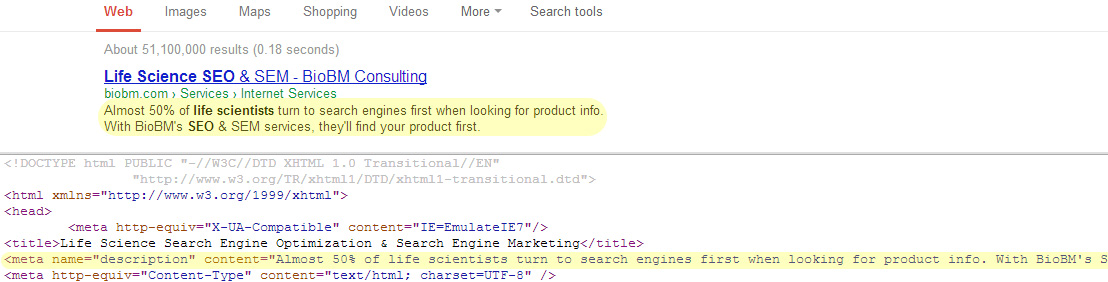
You've seemingly done everything right – you have lots of high-quality backlinks pointing to the relevant page and the page has an optimized title, URL, and header tags. You have well-optimized content and lots of it, and your domain and site have "aged".
Think Like The Customer
A little while ago we discussed the importance of adopting the scientist-customer's perspective in your marketing to create communications that have a customer-centric viewpoint – showing an understanding of their wants and needs and offering a solution.

A Lesson in Communication
One of the most timeless lessons in the art of persuasive communication is about 2350 years old and written by Aristotle. Rhetoric, and particularly the second book of Rhetoric contains fundamentals which every life science marketer with a role in marketing communications should understand and adhere to.
Get the latest Life Science Marketing Insights directly in your inbox
Occasional articles, reports, and practical ideas from BioBM — no spam, unsubscribe anytime. We’ll email a confirmation link before you’re added to the list.